


Pass it on...
Found this blog interesting? Share it!


Standing Desk Height Guide: Small, Tall and Corner Desks
The right standing desk depends on three things: how much room you have, how tall you are, and how much worktop you need. Get any of these wrong and you end up with a desk that is too big for the room, too low when you stand, or too high when you sit.
This guide covers the questions we hear most often: which desk suits a small space, what the difference is between two stage and three stage legs, which desk suits tall users and anyone who needs to sit low, and when an L-shaped corner desk is the better choice. For a wider comparison of desks and prices, see our guide to electric standing desks.
Standing desks for small spaces
For a small room, a compact desktop on a single motor frame such as the Yo-Yo DESK PRO 1 is the best-value starting point. It is the lowest-cost frame in our range at £299.96 ex VAT, and its frame width is adjustable so it fits a wide range of desktop sizes.
| Yo-Yo DESK PRO 1 | Specification |
|---|---|
| Motor | Single motor |
| Leg type | Two stage |
| Height range (frame only) | 72.5 cm to 122.5 cm |
| Desktop sizes | 100 x 60 cm, 120 x 70 cm, 120 x 80 cm, 140 x 80 cm, or frame only |
| Frame width adjustment | 85 cm to 129 cm |
| Weight capacity | 70 kg |
| Lift speed and noise | 2.5 cm per second, below 50 dB |
| User height | Up to 185 cm (6ft 1in) |
| Warranty | 5 years on the frame |
Source: Yo-Yo DESK PRO 1 product page. The base desk has a simple up and down control, and a digital memory switch is available separately.
To get the most from a small space:
- Choose the smallest desktop that fits your work. A 100 x 60 cm top is enough for a laptop and one screen. Go to 120 x 70 cm if you also need paperwork space.
- Check the room at full height. Make sure shelves, windows and radiators do not get in the way when the desk is fully raised.
- Leave space to move your chair. The desk travels in height only, so keep clear room behind and under it.
- Match the load to the motor. The PRO 1 carries 70 kg, which suits a laptop and a screen. For several monitors, look at the dual motor PRO 2, which carries 100 kg.
If you cannot change the desk at all, a standing desk converter turns your existing desk into a sit-stand one. Our portable LEARN desk is another option for flexible rooms.
Two stage vs three stage legs: which do you need?
Three stage legs travel further than two stage legs, so they go both lower and higher. Choose three stage if you are tall or if you need the desk to drop lower than most.
Each leg on an electric desk is made of telescoping sections. Two stage legs have two sections, and three stage legs have three. The extra section lets the desk collapse to a lower minimum height and extend to a higher maximum.
| Desk | Legs | Frame height range | Suits users up to | Price (ex VAT) |
|---|---|---|---|---|
| PRO 1 | Two stage | 72.5 cm to 122.5 cm | 185 cm (6ft 1in) | £299.96 |
| PRO 2 | Two stage | 70 cm to 120 cm | 185 cm (6ft 1in) | £399.96 |
| PRO 2+ | Three stage | 62 cm to 127 cm | 203 cm (6ft 8in) | £499.96 |
| EXEC 2+ | Extra height | 62 cm to 127 cm | 203 cm (6ft 8in) | £449.96 |
Source: Yo-Yo DESK product pages. Heights are for the frame only, so add the thickness of your desktop. The PRO 2+ page gives a maximum of 130 cm including the desktop.
If you are tall
If you are taller than 185 cm (6ft 1in), choose a three stage desk. A standing desk should sit at elbow height, so tall users need more height than a two stage frame provides. The PRO 2+ and EXEC 2+ are designed for users up to 203 cm.
If you need the desk to go lower
A lower minimum height helps shorter users, and anyone who sits in a lower chair. Three stage and extra height desks start at about 62 cm, compared with 70 cm to 72.5 cm for the two stage PRO 2 and PRO 1. The EXEC 2+ page also describes its 62 cm lowest setting as suitable for shorter people at a sitting height.
How to check which you need
- Sit with your feet flat and your elbows at about 90 degrees. Measure from the floor to the underside of your forearms. This is your sitting desk height.
- Stand upright with your elbows at about 90 degrees and measure the same way. This is your standing desk height.
- Add the thickness of your desktop to the frame figures in the table above, then check that both of your measurements fall inside the range.
If either measurement falls outside a two stage range, choose a three stage desk.
L-shaped and corner standing desks
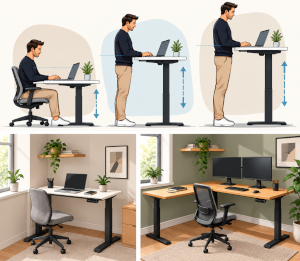
An L-shaped corner desk gives you far more worktop than a straight desk in the same room, because it uses the corner that a straight desk wastes. It suits anyone with several screens, lots of paperwork, or a room where a straight desk would leave dead space.
Our corner range is height adjustable across 62 cm to 130 cm, and the two wings can be mixed and matched in small, medium and large sizes to fit tight or irregular rooms. You can also choose left or right hand set up and a corner angle of 90, 120 or 135 degrees.
| Desk | Best for | Weight capacity | Price (ex VAT) |
|---|---|---|---|
| PRO 3 | Standard height corner desk | 150 kg | £666.62 |
| PRO 3+ | Extra height, for taller users | 150 kg | £749.95 |
| FLYTTA 3 | Premium corner desk | 160 kg | £1,199.95 |
Source: Sit-Stand.com corner desks category, 18 October 2026. Prices are frame only.
Before you order a corner desk:
- Measure both walls. Check the length of each side and leave room to pull your chair out.
- Pick the right hand. Decide whether the long wing should run to the left or the right of where you sit.
- Check the corner angle. A 90 degree corner suits a standard room corner, while 120 and 135 degree angles open up the space for a more open layout.
- Choose standard or extra height. If you are tall, pick the PRO 3+.
Quick chooser
| Your situation | Choose | Why |
|---|---|---|
| Small room, one screen | PRO 1 with a 100 x 60 cm or 120 x 70 cm top | Lowest-cost frame, compact desktop options |
| Small room, heavier equipment | PRO 2 | Dual motor, carries 100 kg |
| Taller than 185 cm (6ft 1in) | PRO 2+ or EXEC 2+ | Three stage or extra height, up to 127 cm frame height |
| Need the desk to go lower | PRO 2+ or EXEC 2+ | Lowest setting around 62 cm |
| Several screens or lots of paperwork | PRO 3 corner desk | L-shaped worktop, 150 kg capacity |
| Tall and want a corner desk | PRO 3+ | Extra height corner desk |
| Cannot replace your desk | Standing desk converter | Works on the desk you already have |
Frequently asked questions
What is the difference between a two stage and a three stage standing desk?
Two stage legs have two telescoping sections and a smaller height range. Three stage legs have three sections, so they go lower and higher, which suits tall users and anyone who needs a low sitting height.
What size standing desk is best for a small room?
A 100 x 60 cm or 120 x 70 cm desktop is usually enough for a laptop and one screen. Measure your space at full height as well as at floor level, so the desk does not hit shelves or windows when raised.
How tall do you need to be for a three stage desk?
If you are taller than about 185 cm (6ft 1in), a three stage or extra height desk is the safer choice. Shorter users who need a lower minimum height should also look at three stage desks.
Are corner desks worth it?
Yes, if you use several screens or need a lot of worktop, or if you have a room corner a straight desk would leave empty. They cost more than a straight desk, with our corner desks starting from around £667 ex VAT for the frame.
Can I choose left or right hand on a corner desk?
Yes. Our corner desks can be set up left or right handed, and the wings can be mixed in small, medium and large sizes.
Find the right desk
Browse our full range of standing desks or our corner desks, or contact us and we will help you choose the right size and height for your space.
Contact Us for Desk Advice


